
Antibody facts for kids
An antibody (also called an immunoglobulin) is a special protein used by your body's immune system. Think of it as a tiny, Y-shaped detective. Its main job is to find and neutralize harmful invaders like bacteria and viruses. These invaders have unique markers called antigens. Each antibody is designed to recognize and attach to a specific antigen, much like a key fits a lock.
When an antibody binds to an antigen, it can do two things. It can "tag" the invader, signaling other immune cells to attack it. Or, it can directly stop the invader from causing harm. For example, it might block a virus from entering your cells. Antibodies can float freely in your blood or be attached to the surface of certain immune cells. They are a crucial part of how your body stays healthy and fights off sickness.

Contents
How Your Body Makes Antibodies
Your body's immune system has special cells called B cells. These B cells are like factories that produce antibodies. When a B cell encounters an antigen it recognizes, it gets activated.
Once activated, B cells can change into "plasma cells." Plasma cells are super producers. They make and release huge amounts of antibodies into your blood. These antibodies then travel throughout your body to find and fight invaders. Some B cells also become "memory B cells." These cells remember the invader for a long time. If the same invader comes back, memory B cells quickly make new antibodies to fight it off faster.
How Antibodies are Built
Antibodies are large proteins, shaped like the letter "Y". They are made of four smaller chains linked together. There are two longer chains called heavy chains and two shorter chains called light chains.

Each arm of the "Y" shape has a special area. This area is called the antigen-binding site. It's like the "lock" part of the lock-and-key system. This site is unique for each antibody. It perfectly matches a specific part of an antigen, called an epitope.
The "trunk" of the "Y" is called the Fc region. This part doesn't bind to antigens directly. Instead, it helps the antibody connect with other immune cells. It also helps trigger other immune responses.


Different Types of Antibodies
Your body makes five main types, or classes, of antibodies. Each class has a slightly different job and is found in different parts of your body. These classes are named IgA, IgD, IgE, IgG, and IgM. "Ig" stands for immunoglobulin.
- IgA: These antibodies protect areas like your gut, respiratory tract, and urinary system. They are also found in saliva, tears, and breast milk. IgA helps stop germs from settling in these places.
- IgD: These are mainly found on the surface of B cells. They act as sensors, helping B cells detect when an antigen is present.
- IgE: These antibodies are involved in allergic reactions. They bind to allergens (things that cause allergies) and trigger cells to release chemicals like histamine. This causes allergy symptoms. IgE also helps protect against parasitic worms.
- IgG: This is the most common type of antibody. IgG provides most of your body's protection against many different pathogens. It's the only antibody that can cross from a mother to her baby during pregnancy, giving the baby early protection.
- IgM: These are often the first antibodies your body makes when it encounters a new pathogen. They are very good at clumping pathogens together, making them easier for other immune cells to clear.
How Antibodies Fight Germs
Antibodies work in several clever ways to protect you from illness.

- Antibodies (A) and pathogens (B) free roam in the blood.
- The antibodies bind to pathogens, and can do so in different formations such as:
- opsonization,
- neutralisation, and
- agglutination.
- A phagocyte (C) approaches the pathogen, and the Fc region (D) of the antibody binds to one of the Fc receptors (E) of the phagocyte.
- Phagocytosis occurs as the pathogen is ingested.
- Neutralization: Some antibodies block parts of a virus or bacteria that they need to infect your cells. This stops the invader from causing harm.
- Agglutination: Antibodies can "glue" many invaders together into clumps. These clumps are easier for other immune cells to find and destroy.
- Precipitation: Similar to agglutination, antibodies can clump together tiny, soluble antigens. This makes them fall out of solution and become easy targets for removal.
- Complement Activation: Antibodies can signal a group of proteins called the complement system. These proteins then attack the foreign cells, causing them to burst. They also attract other immune cells to the fight.
After fighting off an infection, some B cells become memory B cells. These cells remember the specific antigen for years. If you encounter the same germ again, these memory cells quickly produce new antibodies. This helps you fight off the infection much faster and often prevents you from getting sick again.

How Antibodies Become Diverse
Your body can make billions of different antibodies. Each one is designed to recognize a unique antigen. This amazing diversity is important because there are countless types of germs in the world.
Even though your body has a limited number of genes, it uses clever genetic tricks to create this huge variety of antibodies. These tricks allow the parts of the antibody genes to mix and match in many ways. This ensures that your immune system is ready for almost any invader it might encounter.
Over time, antibodies can even improve their ability to bind to an antigen. This process makes them even more effective at fighting off infections.
The Story of Antibodies
The study of antibodies began a long time ago. In 1890, scientists Emil von Behring and Kitasato Shibasaburō discovered that something in the blood could fight against toxins. They called this idea humoral immunity.
In 1891, Paul Ehrlich first used the term "antibody" (Antikörper in German). He suggested that cells have "side-chains" that act like locks, binding to toxins like keys.
Later, in the 1920s, Michael Heidelberger and Oswald Avery showed that antibodies are made of protein. In the 1940s, Linus Pauling confirmed the "lock-and-key" idea. He showed that the shape of antibodies and antigens is key to how they bind.
A big breakthrough came in the 1960s. Scientists Gerald Edelman and Rodney Porter figured out the full structure of an antibody. They discovered it was made of heavy and light chains linked together. For this important work, they won the Nobel Prize in Physiology or Medicine in 1972.

Other scientists, like Kimishige Ishizaka and Teruko Ishizaka, discovered different types of antibodies, such as IgE, which is involved in allergic reactions. These discoveries helped us understand how our immune system works.
Antibodies in Medicine
Antibodies are very important in medicine, both for finding diseases and for treating them.
Finding Diseases
Doctors often use tests to find specific antibodies in your blood. For example, if you have certain antibodies, it can show if you've been infected with a virus like Epstein–Barr virus. These tests help doctors diagnose illnesses.
Antibodies can also help detect autoimmune disorders. In these conditions, your immune system mistakenly attacks your own body. Blood tests can find antibodies that target your body's own cells.
Treating Diseases
Antibodies are used as medicines to treat many diseases. For example, special antibodies called monoclonal antibodies are used for conditions like rheumatoid arthritis, multiple sclerosis, and many types of cancer. These antibodies are designed to target specific cells or proteins in the body.
For people with weak immune systems, doctors can give them ready-made antibodies. This is called passive immunity. It helps protect them from infections for a short time.
Protecting Babies
Antibodies play a vital role in protecting babies. During pregnancy, a mother's IgG antibodies can cross the placenta to her unborn baby. This gives the baby protection against diseases the mother is immune to.
After birth, breast milk also contains antibodies, mainly IgA. These antibodies help protect the baby's digestive system from infections.
There's also a special treatment for Rh-negative mothers carrying Rh-positive babies. Doctors can give the mother anti-RhD antibodies. This prevents her immune system from attacking the baby's red blood cells.
Antibodies in Research
Scientists use antibodies in many ways to study biology and develop new treatments.

Researchers can create specific antibodies by injecting an antigen into an animal. The animal's immune system then produces antibodies against that antigen. These antibodies can be collected from the animal's blood.
Scientists also make special antibodies called monoclonal antibodies in labs. These are all identical and target a single specific epitope.
In research, purified antibodies are used to identify and locate proteins inside cells or tissues. They help scientists understand what proteins are present and where they are located. For example, they are used in techniques like Western blot and immunofluorescence. These methods help us learn more about how our bodies work and what goes wrong in diseases.
Images for kids
-
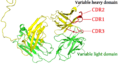
The complementarity determining regions of the heavy chain are shown in red (PDB 1IGT)
-
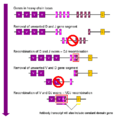
Simplified overview of V(D)J recombination of immunoglobulin heavy chains
-
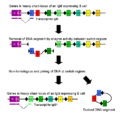
Mechanism of class switch recombination that allows isotype switching in activated B cells


See also
 In Spanish: Anticuerpo para niños
- Affimer
- Anti-mitochondrial antibodies
- Anti-nuclear antibodies
- Aptamer
- Colostrum
- ELISA
- Humoral immunity
- Immunology
- Immunosuppressive drug
- Intravenous immunoglobulin (IVIg)
- Magnetic immunoassay
- Microantibody
- Monoclonal antibody
- Neutralizing antibody
- Optimer Ligand
- Secondary antibodies
- Single-domain antibody
- Slope spectroscopy
- Surrobody
- Synthetic antibody
- Western blot normalization
